Schwarzschild geometry
The meaning of the metric

The Schwarzschild metric is an exact solution to a simplified version of the spacetime curvature described by general relativity - the space deformation around a massive, stationary, non-rotating, spherical object. The metric dates to barely a month after Einstein’s publication of general relativity. It directly follows from the concept of the spacetime interval. Here is the formula, using polar units (r, theta, phi). It is generally used with “natural units” for the constants, which all equal 1.
s is the time-like spacetime interval. (This is directly from special relativity.)
Tau is the proper time perceived by an observer at that point.
t is the time as measured by a distant observer.
G is the gravitational constant. (To convert it to “natural” units, where G = 1, use a conversion factor of 1 kg = 7.426e-28 meters.)
c is the speed of light (299,792,458 m/s).
r is the radius from the center of the massive object, as measured by a distant observer.
Theta and phi are spherical angles with theta measured from the “north pole”.
2Gm/c² equates to the “point of no return” event horizon of a black hole.
The (1 - 2Gm/c²r) factors should be their square roots, but since they’re then squared, that part is omitted.
This is just a more complicated version of the generic spacetime interval formula.
But what does the metric mean, physically? Let us, as always, return to a simple diagram of an object (in this case, a black hole) deforming the field of potential energy. In this case, everything has been converted to “natural “ units so all constants, including 2Gm/c², equal 1. We then take the square root to account for the left hand side (ds) being squared. The diagram below subtracts 1 to make it similar to previous diagrams in this series.
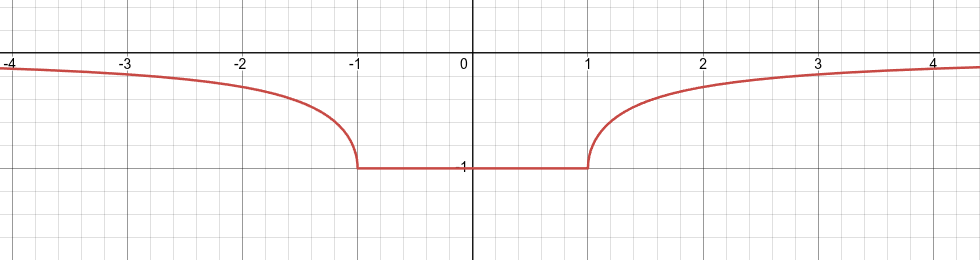
The geometry tells the story, but it speaks subtly. On the vertical scale, 0 is the top, where 100% of energy lies waiting in potentia. -1 is the rock bottom - there is no more potential energy to withdraw from the system at that point. There is no singularity at the center. There is nothing. There can be nothing. All potential energy has been used up by the physical shell at the event horizon.
In the metric, the time portion (c²dt² above) shows an inherent velocity at a point at distance r from the black hole’s center equal to the Newtonian escape velocity (or rather, the capture velocity). By the inexorable laws of geometry and calculus, we know that the actual level (distance from zero) at any point in the diagram must therefore equate to an inherent velocity, as a fraction of c. By no coincidence whatsoever, this equates to the escape velocity at that point. In the case of the event horizon, the capture velocity = -1 = c.
We know from prior examinations that if we take the tangent angle (slope) of the curve at any point outside the event horizon, the sine gives you the velocity and the cosine the Lorentz alpha factor (time dilation). So at the event horizon, not only is the capture velocity the speed of light, but so is the acceleration! That makes the alpha factor zero, so no time passes for a local observer at that point. The tangent gives the momenergy, which at the event horizon would need to be infinite.
There are several explanatory videos12 showing how spacetime “flows” towards a massive object. Most of these explanations somewhat miss the point. Nothing is actually moving. It’s an inherent property, and one of the key weirdness factors of general relativity.
What about the dr² portion of the metric? As you can see, it is simply the inverse of the time factor. That’s the difference between the Lorentz alpha and gamma factors. If the local observer perceives time flowing at half the rate a distant observer sees, he must therefore measure distances to be half as far as the distant observer would. That’s the only way to keep the speed of light a constant for every inertial observer. Since the dr² in the formula is the distance the distant observer measures, you have to then double that to get the value for the local observer.
The other factors account the effects of motion in directions not directly towards the central mass.
That’s it. That’s all there is to this. It just took me years to figure it out, with lots of missteps and misunderstandings along the way.
Ok, but the assumption that the speed of light is constant is false, we can see gravitational lensing. Space has an observed refractive index that depends on depth in a gravitational well. Gauge theory gravity (see Chris Doran's paper: https://arxiv.org/abs/gr-qc/0405033) works in flat euclidean space. For something without tensor notation, I like José B. Almeida's idea: https://arxiv.org/abs/physics/0601194
The curved-space idea fundamentally is nonsense, that's not how spatial geometry works or can work on the most basic mathematical level. I think it was a psyop intended to derail physics.